
Rotary tables for 4-axis and 5-axis applications serve as core functional components of multi-axis CNC machines. Without these critical parts, 4-axis and 5-axis machining centers cannot fulfill their designated functions. To put it simply: equipping a 3-axis machine with one rotary axis creates a 4-axis unit, while adding two rotary axes upgrades it to a 5-axis machine.
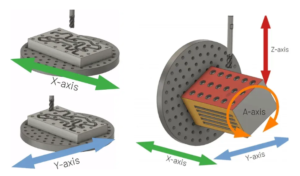
3-Axis CNC Machining
A 3-axis CNC system refers to three linear moving axes corresponding to vertical, longitudinal and transverse movements following the Cartesian coordinate system. Parts can only be machined on a single surface per setup, making 3-axis equipment ideal for flat-component production.
3-axis CNC milling remains one of the most common and widely adopted machining processes. Workpieces stay stationary during processing, while cutting tools travel along X, Y and Z axes to remove material. As a basic CNC configuration, it works well for parts with straightforward geometries yet struggles with intricate complex structures. Since only three linear movements are available, operators frequently re-clamp workpieces manually to complete full shaping, resulting in lower overall processing efficiency compared to 4-axis and 5-axis alternatives.
4-Axis CNC Machining
4-axis CNC milling introduces a fourth rotational axis, defined as the A-axis rotating around the X-axis, complementing the original X, Y and Z linear axes. Many 4-axis machine tools are also configured with a workpiece rotary B-axis, enabling hybrid milling and turning capabilities on one piece of equipment.
This technology is the preferred solution for lateral hole drilling and curved-surface machining on cylindrical workpieces. It drastically shortens production cycles while maintaining superior dimensional precision.
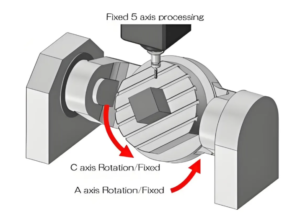
5-Axis CNC Machining
Building upon 4-axis setups, 5-axis CNC milling incorporates an extra rotary B-axis revolving around the Y-axis; certain machine models mark the workpiece rotary axis as either B-axis or C-axis.
Supported by structurally reinforced rotary assemblies to offset component weight, cutting tools on 5-axis machines can approach workpieces from nearly any spatial orientation. This breakthrough unlocks the manufacturing of sophisticated geometric components previously difficult or impossible to produce via conventional machining.
Compared with 3-axis and 4-axis CNC equipment, 5-axis machining systems deliver outstanding flexibility, productivity and versatility. Its multi-angle cutting capacity enables high-efficiency fabrication of free-form profiles and irregular complex geometries.