
For technicians engaged in electrical automation, electrical maintenance and equipment commissioning, motors are daily working partners. However, many people with years of working experience still struggle to distinguish between three-phase asynchronous motors, stepper motors, servo motors and DC motors. They get confused when selecting models, fail to understand wiring principles, and keep running into pitfalls during commissioning. Common issues include equipment vibration, unstable rotational speed and inaccurate positioning.
Today we will thoroughly break down the four most widely used industrial motors, including their working principles, core features, applicable scenarios, advantages and disadvantages. After reading this guide, you will never mix them up again and can directly apply the rules for motor selection.
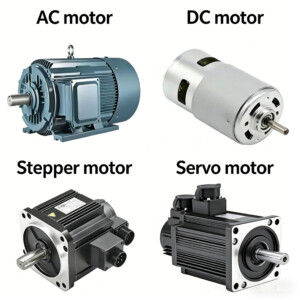
I. Four Mainstream Industrial Motors
1.Three-phase Asynchronous Induction Motor
2.Stepper Motor
3.Servo Motor
4.DC Motor (Brushed / Brushless)
II. Detailed Comparison of the Four Motors
1. Three-Phase Asynchronous Induction Motor
Core Features: Low cost, durable, maintenance-free, the most widely adopted motor type
Working Principle: Energization generates a rotating magnetic field, which drives rotor rotation through electromagnetic induction; no complex control algorithms are required.
Advantages: Simple structure, robust and reliable, low price, suitable for long-term continuous operation.
Disadvantages: Incapable of precise positioning, mediocre speed regulation accuracy, weak low-speed torque.
Applicable Scenarios: Water pumps, fans, conveyor belts, air compressors, main drive of general machine tools, and constant-speed operating equipment.
2. Stepper Motor
Core Features: Positioning capability, low cost, open-loop control
Working Principle: Rotates step by step in response to pulse signals; the rotation angle is proportional to the number of input pulses.
Advantages: Self-locking when powered off, acceptable positioning accuracy, cost-effective, no encoder required.
Disadvantages: Prone to step loss at high speeds, significant torque drop at high rotation speeds, no overload feedback signal.
Applicable Scenarios: Small manipulators, engraving machines, 3D printers, indexing rotary tables, simple point-to-point positioning equipment.
3. Servo Motor
Core Features: High precision, high rotational speed, closed-loop control, fast response
Working Principle: Equipped with a built-in encoder to feed back position and speed data in real time; errors are corrected via closed-loop control.
Advantages: Ultra-precise positioning, stable high-speed operation, high torque, strong overload capacity, no step loss.
Disadvantages: High unit price, expensive matching drives, relatively complicated commissioning process.
Applicable Scenarios: Automated production lines, robot joints, precision cutting equipment, CNC machine tools, high-precision positioning systems, high-speed reciprocating motion devices.
4. DC Motor (Brushed / Brushless)
Core Features: Large starting torque, easy speed regulation, compact size
Working Principle: Driven directly by DC power supply; brushed motors rely on carbon brushes for mechanical commutation, while brushless motors adopt electronic commutation.
Advantages: High starting torque, smooth speed adjustment, simple control, compact outline dimension.
Disadvantages: Brushed versions suffer from easy carbon brush wear and limited service life; brushless DC motors have higher procurement costs than brushed ones.
Applicable Scenarios: Small industrial control equipment, electric vehicles, electric valves, small home appliances, miniature transmission mechanisms.
III. Core Differentiation Summary (Save for Quick Reference)
(Note: The original text only mentioned this heading without specific content, reserved as a title)
IV. Quick Mnemonics for Motor Selection
1.Only continuous rotation required, no positioning demand → Choose three-phase asynchronous induction motor
2.Fixed stop positioning needed, limited budget, low-speed operation only → Choose stepper motor
3.Demands ultra-precise positioning, high running speed and high control accuracy → Directly adopt servo motor
4.Compact footprint, simple speed control, small-sized equipment → Choose brushed or brushless DC motor