
01 What Is Underway in the Machining Industry?
Halfway through 2026, the machining industry has reached unprecedented momentum. At the 14th China CNC Machine Tool Fair 2026 (CCMT2026) held in April, a total of 441 five-axis linkage machine tools were on display, among which 235 were five-axis machining centers. Almost every exhibitor brought its self-developed five-axis models to the show. Industry observers commented: “The explosive growth of five-axis machine tools is no accident, but driven by both rigid market demand and national strategic priorities.”
Meanwhile, the 15th Five-Year Plan has explicitly proposed adopting extraordinary measures to push forward the research on key core technologies of industrial mother machines and other priority sectors across the entire industrial chain. Domestic five-axis machine tools are evolving from “functional prototypes” to “high-quality finished products” and from “lab samples” to “mass-produced commodities”.
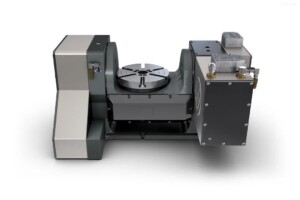
Against this backdrop, 4th-axis rotary tables and 5th-axis rotary tables, as core functional components of CNC machine tools, are playing an increasingly pivotal role.
02 4th-Axis Rotary Tables: The First Step for Upgrading 3-Axis Machine Tools
Conventional 3-axis machining centers only enable linear movement along the X, Y and Z axes. For tasks such as cylindrical surface drilling, circumferential groove milling and polyhedral machining, repeated clamping and repositioning are inevitable.
The 4th-axis rotary table adds one rotational axis to a 3-axis machine tool. Its greatest value lies in automatically rotating workpieces on the machine, allowing complete machining of multiple surfaces in a single setup.
Take the roller-cam 4th-axis rotary table developed by Getu Precision Machinery as an example. It adopts preloaded cam and needle roller bearings to realize backlash-free rolling transmission, featuring zero backlash, high rigidity, heavy load capacity and high efficiency. Compared with traditional worm-and-wormgear rotary tables, the roller-cam structure delivers remarkable advantages in precision retention and backlash control.
For small and medium-sized enterprises mainly processing revolving parts, retrofitting a 4th-axis rotary table is a cost-effective solution to expand the processing capacity of existing 3-axis equipment. In a fiercely homogenized machining market, this upgrade not only boosts machining accuracy and finished product yield, but also broadens the scope of order acceptance.
03 5th-Axis Rotary Tables: The Top Choice for Complex Free-Form Surface Machining
If 4th-axis rotary tables solve the problem of multi-sided machining, 5th-axis rotary tables tackle the challenge of free-form surface processing.
Equipped with two rotary axes (e.g., Axis A and Axis C), 5th-axis rotary tables support simultaneous five-axis linkage with the three linear axes. This allows cutting tools to approach workpieces at any spatial angle, with real-time coordinated motion between rotary and linear axes during processing.
The core strength of 5th-axis rotary tables is one-time clamping for full completion of all machining processes. The entire production process adopts a unified reference coordinate system without repeated workpiece disassembly and re-clamping, fundamentally eliminating error accumulation caused by repeated positioning. Once fixed on the rotary table, the workpiece can undergo all procedures including milling, drilling and tapping in one go.
For this reason, 5th-axis rotary tables have become critical equipment for manufacturing aerospace components, precision molds and medical implants. Taking aero-engine blisks as an example, domestic five-axis equipment can cut the unit production cost by 40%–50% and shorten delivery lead time by 60%.
04 Getu Precision Machinery: Technological Breakthrough of Domestic Rotary Tables
In the domestic rotary table sector, Getu Precision Machinery (Suzhou) Co., Ltd. stands out as a noteworthy enterprise.
Getu Precision specializes in the R&D, design and manufacturing of roller-cam 4th-axis and 5th-axis rotary tables, adhering relentlessly to the philosophy of “striving for perfection”. It follows a business layout of R&D in one location, production across two regions and global sales network. Its R&D team engages senior technical experts from Japan and Taiwan, who have delved deep into core roller-cam technology for years.
The roller-cam mechanism constitutes Getu’s core technological moat. Compared with traditional worm gear rotary tables, the roller-cam structure achieves backlash-free transmission with prominent edges in precision retention, structural rigidity and service lifespan. Getu’s full product portfolio covers 4th-axis rotary tables, 5th-axis rotary tables, 5-axis CNC indexing plates and horizontal indexing plates, all core functional parts for machine tools.
On the production side, Getu has built a modern manufacturing base in Suzhou, equipped with over 10 DMG MORI five-axis machining centers from Germany and more than 10 Mazak horizontal CNC machining centers imported from Japan. Its annual production capacity of rotary tables reaches up to 10,000 units. Such world-class production hardware guarantees consistent product precision and stable delivery for bulk orders.
From the collective debut of 441 five-axis machine tools at CCMT2026 to the high strategic priority placed on industrial mother machines in the 15th Five-Year Plan, the irreversible trend of multi-axis and high-end upgrading in the machining industry has been clearly defined.
In this transformative journey, 4th-axis and 5th-axis rotary tables serve as the key enablers for upgrading from 3-axis to multi-axis machining, whose value is gaining growing recognition among manufacturing enterprises. Whether it is the lightweight upgrade of 3-axis machine tools via 4th-axis rotary tables, or tackling tough complex surface machining tasks with 5th-axis rotary tables, the selection of appropriate rotary table solutions has become a watershed that differentiates competitiveness among machining workshops.
Domestic manufacturers focusing on core technologies and roller-cam structures like Getu Precision Machinery are providing solid technical support for the precision machining upgrading of China’s manufacturing industry with high-performance products featuring zero backlash, ultra-high accuracy and extended service life.